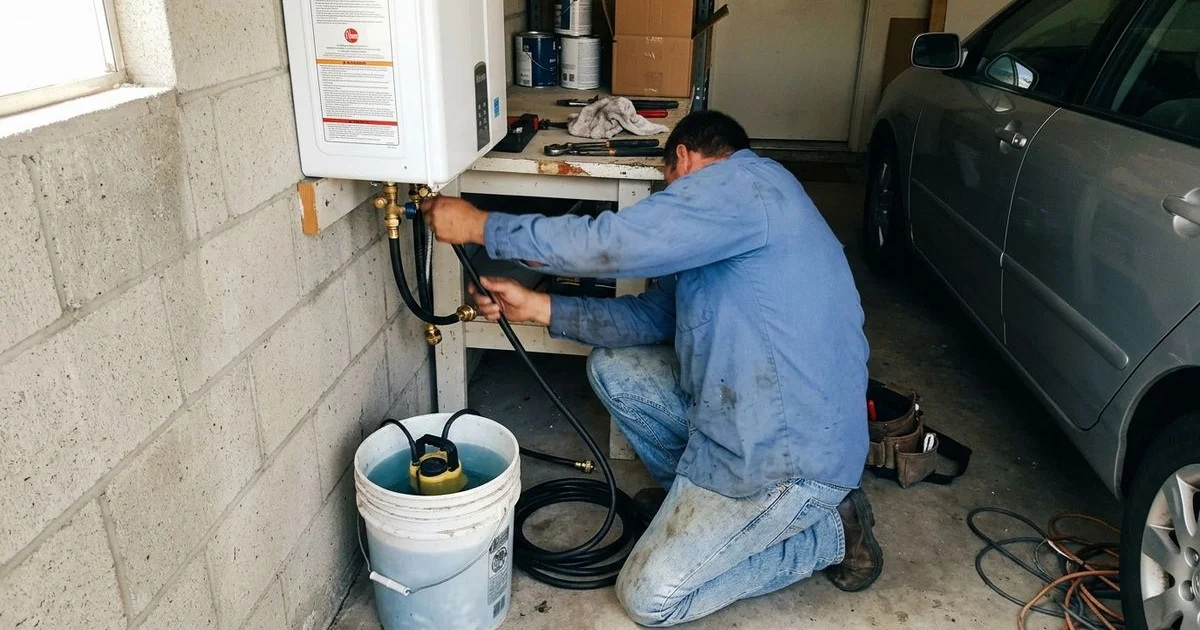
Tankless water heaters are sold on long life and endless hot water. Both promises assume the heat exchanger stays clear. In Yuma, where the city rates its water at 18 to 22 grains per gallon, that only happens with a descaling schedule most owners were never told about at installation.
Why tankless units scale so fast
A tank heater warms 40 or 50 gallons slowly, and sediment falls to the bottom, out of the way. A tankless unit pushes water through narrow passages and heats it in seconds. That fast, intense heating is exactly what drives minerals out of the water, and in passages that narrow, even a thin layer matters.
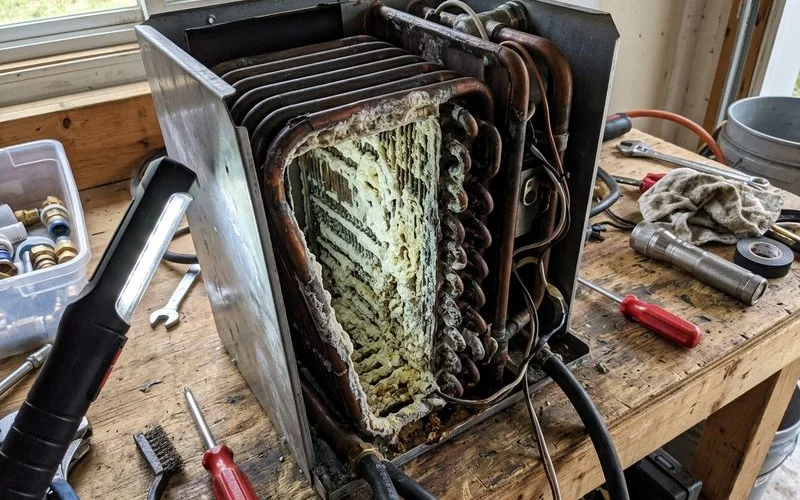
Manufacturer intervals are written for average water. Very hard water starts at about 10.5 grains per gallon. The city supply here runs at roughly twice that, so the factory schedule is a starting point, not the answer.
A realistic schedule
| Your household | Descaling interval |
|---|---|
| Untreated city water, 1 to 2 people | Every 12 months |
| Untreated city water, 3 to 4 people | Every 9 to 12 months |
| Untreated city water, 5+ people or heavy use | Every 6 to 9 months |
| Softener upstream, working properly | Every 18 to 24 months, confirmed by inspection |
| Winter home used part of the year | Every 12 to 18 months, ideally at season start |
| Unit already showing scale error codes | Now, then restart the schedule |
If your unit has been running more than a year and nobody has flushed it, assume it is due.
Winter home owners
Schedule descaling for when you arrive in the fall, not when you leave. Water that sat in the unit all summer can leave deposits, and you want the unit clean heading into the months you actually use it.
How to tell it is overdue
Scale builds in stages:
- Efficiency drops. The burner works harder for the same output. Gas use creeps up.
- Temperature swings. The shower goes hot, then cool, then hot. Flow may weaken.
- Error codes. Many units flag scale buildup, overheating, or low flow and may shut down to protect themselves. Check your manual for the code.
- Heat exchanger damage. A badly scaled exchanger overheats. Repair at this stage is expensive, and replacing the unit often makes more sense.
The goal is to descale during stage one, before you notice anything.
What a descaling visit involves
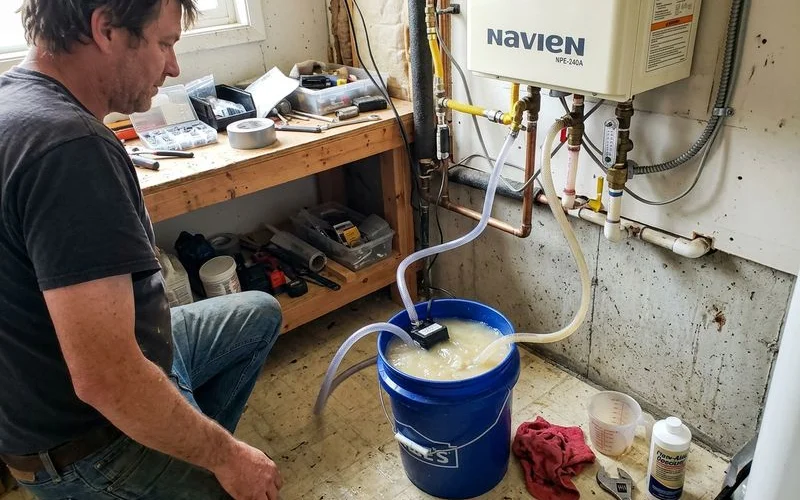
- Shut down and isolate. Power or gas off, then the isolation valves closed.
- Connect the pump. Hoses go on the service ports and run to a bucket with a small circulating pump.
- Circulate descaler. A descaling solution runs through the heat exchanger, usually for about 45 minutes to an hour depending on buildup.
- Rinse. Fresh water flushes the solution out.
- Clean the inlet filter. The small screen on the cold inlet catches debris and is scrubbed.
- Restart and check. Valves open, unit fires, temperature and flow are checked.
Most visits take one to two hours. If the unit was installed without isolation valves, they are added first. It is a one-time upgrade that makes every later visit easier.
How a softener changes the schedule
Softened water carries almost no hardness into the heat exchanger, so scale forms far more slowly. That is the strongest practical argument for water softeners in a home with a tankless unit. You protect an expensive appliance, not just the shower glass.
| Untreated city water | With a softener | |
|---|---|---|
| Descaling interval | 6 to 12 months | 18 to 24 months |
| Risk of heat exchanger damage | Higher | Much lower |
| Efficiency over time | Drifts down between services | Stays closer to rated |
Book it before the error code
Descaling is part of our water heater service. Call Yuma Plumbing Pros any hour, in English or Spanish. If your unit is showing a code, read it out to the assistant so the plumber knows what to expect. Request a free estimate and ask about any service call fee before booking.