Sized for 18-22 gr/gal

Water Softeners Yuma Homes Need, Plus Reverse Osmosis for Drinking Water

Whole-home softeners, under-sink reverse osmosis, and whole-house filtration sized for Yuma's 18 to 22 grain water, where treatment works more like preventive maintenance than an upgrade.

Answered 24/7 English & Spanish Free estimate request All of Yuma County
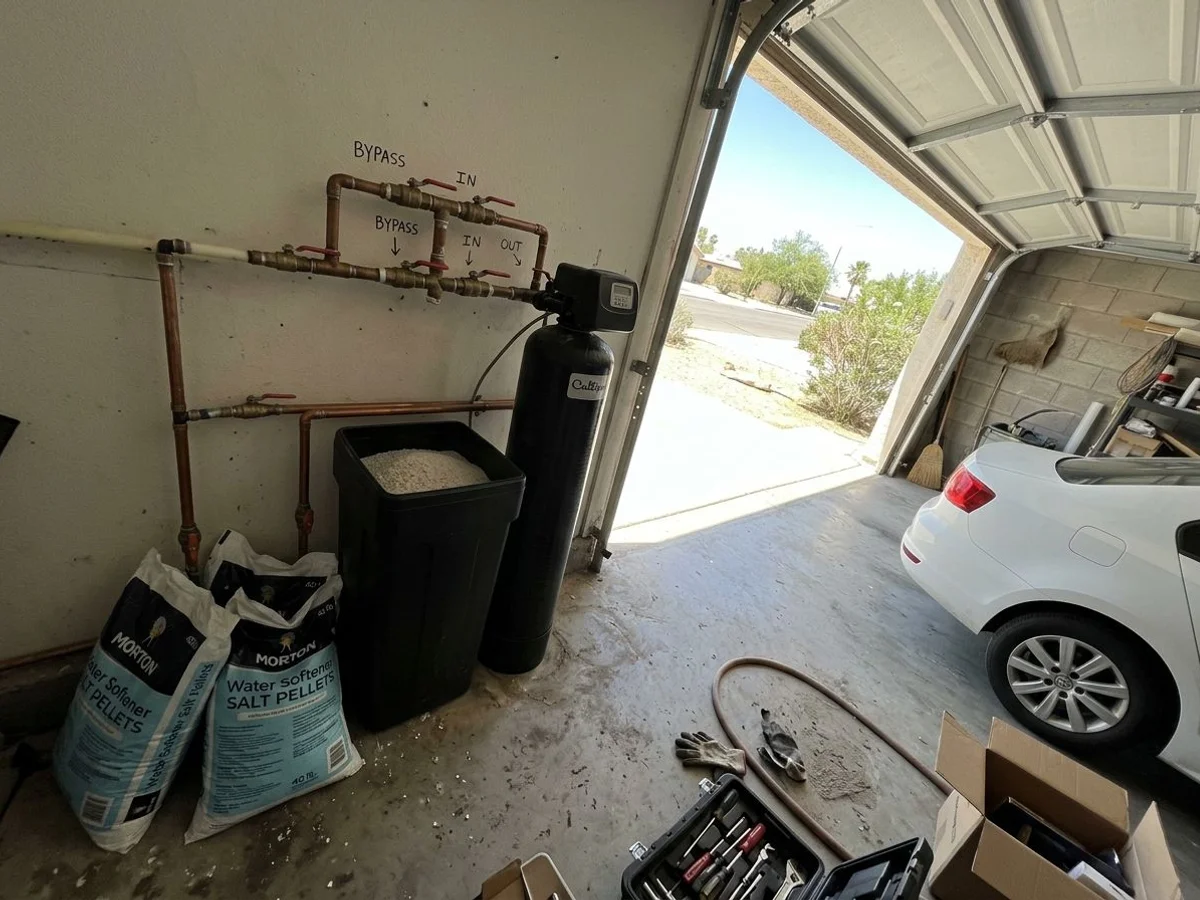
Whole-home water softener and brine tank installed beside the main line in a Yuma garage
Serving all Yuma County
Answered 24/7
Nights, weekends, holidays
Free estimate request
No obligation to proceed
Se habla español
Atendemos en español

Look at the shower head, the faucet aerators, and the inside of the kettle. If there is a white crust on any of them, you are looking at the same minerals that are building up inside your water heater, your valves, and your supply lines right now. You just cannot see those.

In most of the country, a water softener is a comfort upgrade. Here it is closer to routine maintenance. Water softeners in Yuma exist mainly to protect the expensive parts of the plumbing system from scale, and the right setup pays for itself in equipment that lasts as long as it is supposed to. Yuma Plumbing Pros can connect you with a plumber who tests your water, sizes the system properly, and explains what each option will and will not do.

What 18 to 22 Grains Per Gallon Does to a House

The city treats Colorado River water, blends it with groundwater, and rates the result at 18 to 22 grains per gallon. Water above about 10.5 grains is classified as very hard. That puts local tap water at roughly twice the “very hard” line.

Hardness is not a health problem. It is a plumbing and appliance problem, and at these levels a serious one:

  • Water heaters collect scale on the tank bottom, overheat, and fail years early.
  • Tankless units clog their heat exchangers and need frequent descaling.
  • Faucet cartridges and valve seats grind against mineral deposits until they leak or seize.
  • Shower heads and aerators lose flow as scale closes the openings.
  • Dishwashers and washing machines work harder and leave spotting and residue.

Hot summers make it worse. Warm supply water and long stretches above 110 degrees speed up how fast minerals come out of solution.

Softener, RO, Filtration, or Conditioner: Which Does What

These four products get sold together, but they solve different problems.

SystemWhat It DoesWhat It Does Not Do
Ion-exchange softenerRemoves calcium and magnesium for the whole house, protecting pipes, heater, and fixturesImprove drinking water taste on its own
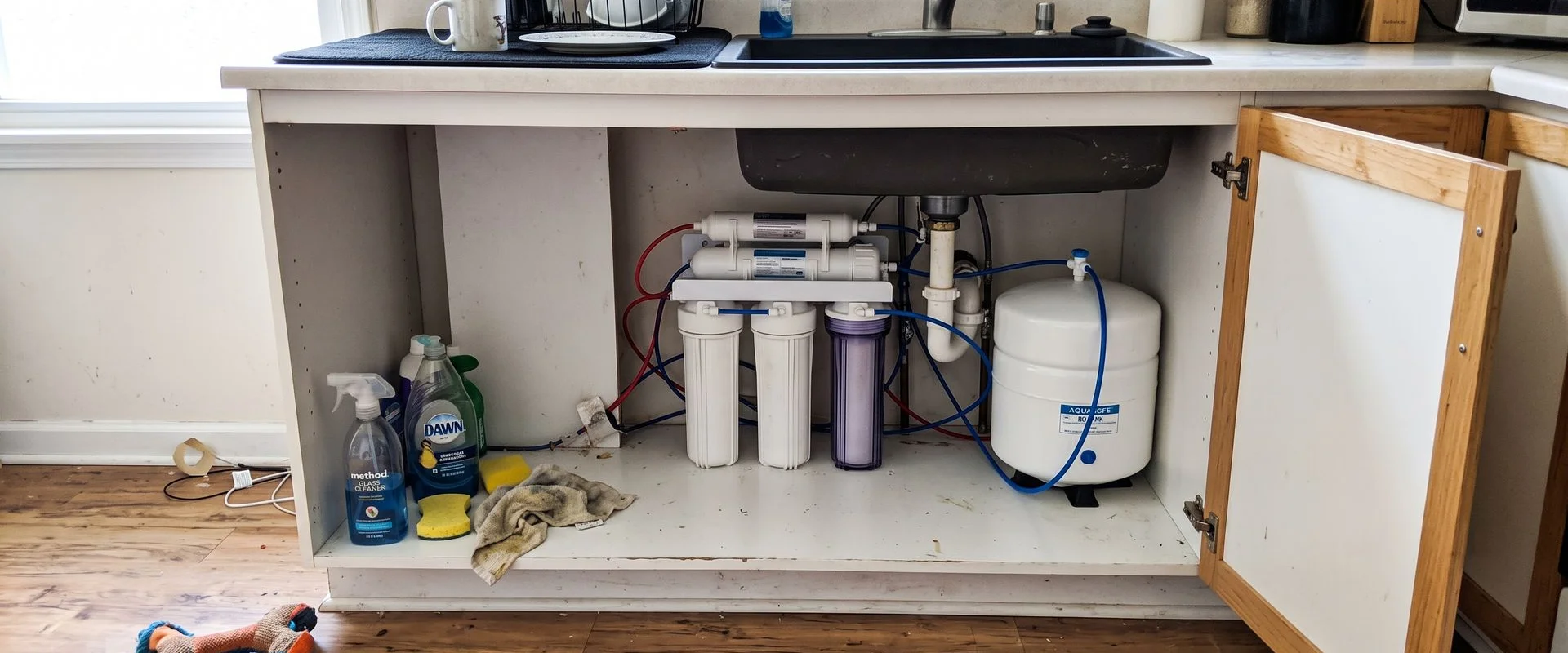
Under-sink reverse osmosisReduces dissolved solids at one drinking tap for better tasteProtect the rest of the plumbing
Whole-house filtrationReduces sediment, chlorine taste, and odor at every tapRemove hardness
Salt-free conditionerChanges how scale forms so it sticks lessRemove hardness; protection is limited at these levels

A common and sensible combination is a softener protecting the plumbing plus an RO tap in the kitchen for drinking and cooking. That covers both concerns without paying twice for the same result.

Test First: Why Your Tap Reading Matters

The city range is a starting point, not a measurement of your home. Outlying communities, including the Foothills, are served by systems that draw on groundwater, so readings there can differ from central neighborhoods. Older galvanized supply lines can also change what arrives at the faucet.

A hardness test at your fixture takes a few minutes, and you see the number. Every sizing decision after that is based on it.

Sizing by Grain Capacity

The math is simple: daily water use multiplied by hardness gives the grains removed per day. The softener needs enough capacity to handle that load and still go several days between regenerations.

Household SizeApproximate Daily UseTypical Capacity Range
1 to 2 people150 gallons32,000 to 40,000 grains
3 to 4 people300 gallons48,000 to 64,000 grains
5 or more400+ gallons64,000 grains and up

An undersized unit regenerates constantly, burns through salt, and wears out its resin early. An oversized one costs more without adding protection. Getting it right matters more than the brand name on the tank.

Common Mistakes When Buying a Softener

  • Choosing by price alone. The cheapest units are usually too small for this water.
  • Leaving the factory hardness setting. The valve must be programmed to your measured hardness, or it under-treats.
  • Skipping the bypass valve. Without one, servicing the softener means shutting off water to the whole house.
  • Putting the brine tank somewhere awkward. Salt bags are heavy. If the tank is hard to reach, refills get skipped.
  • Assuming filtration handles scale. Carbon and sediment filters do nothing for hardness.

Living With the System: Salt, Filters, and Time Away

Softeners in hard-water areas use more salt than in soft-water regions, and many households top up every few weeks. RO systems need filter changes on a schedule and a membrane replacement every few years. If you leave for the summer, put the softener in bypass or vacation mode, and run the taps for a few minutes when you return before using RO water.

Once treatment is in place, the visible changes come fast: less white crust, spot-free glassware, soap that lathers easily. The larger benefits show up quietly over years, in a water heater that keeps its efficiency and faucets that stop needing new cartridges. You can request a free estimate, and our water treatment guides cover sizing in more detail.

Water treatment installs and service are available across Yuma, the Foothills, Somerton, San Luis, and Wellton.
The difference

Why choose us for water treatment

Sizing is the whole job

At 18 to 22 grains, grain-capacity math matters more than brand. Get it wrong and the unit regenerates constantly and dies early.

Tested, not guessed

Hardness gets measured at your fixture before anything is recommended, and you see the reading.

Preventive, not a luxury sell

Untreated water here is what kills heaters, seizes valves, and scales fixtures. Treatment is framed as maintenance because that is what it is.

Softener and RO do different jobs

One protects your plumbing, the other improves drinking water. You will be told if you only need one of them.

Installed to code

Bypass valve, proper drain air gap, and connections done to local plumbing standards.

It pairs with the rest

The same service handles water heaters and fixtures, so treatment gets recommended in the context of what is already failing.

Step by step

How our water treatment work goes

  1. 01

    Test the water

    Hardness gets tested at your tap rather than assumed from the city range. Homes on different water systems do not all read the same.

  2. 02

    Size by grain capacity

    Household size and daily water use against measured hardness. At this hardness, an undersized unit regenerates too often and wears out early.

  3. 03

    Install and set the valve

    Plumbed into the main with a bypass, a drain line with an air gap, and the brine tank placed where you can actually reach it. Regeneration set to your usage.

  4. 04

    Show you the upkeep

    Salt intervals, what the valve display means, and when to have the resin checked. RO filter changes get a schedule too.

Get a free estimate before anything is scheduled

Call and describe the problem. We triage it over the phone, quote it honestly, and there are never surprises when the truck shows up.

Side by side

How we compare

Feature Typical provider Yuma Plumbing Pros
Sizing method Standard model for every house Grain capacity matched to measured hardness and usage
Hardness testing Quoted from the city average Tested at your fixture, shown to you
Salt-free claims Sold as equivalent to softening Honest about what conditioning does at this hardness
Drinking water Bundled whether you need it or not RO recommended only where it solves something
After install Left with a manual Salt and filter schedule walked through with you
On the job

Our water treatment work

Click any photo to enlarge.

Common questions

Water Treatment FAQs

Exactly how hard is the water in Yuma?

The City of Yuma puts its water at 18 to 22 grains per gallon, or about 310 to 380 mg/L, and tells residents to set softeners in that range. Very hard water starts at roughly 10.5 grains, so city water is around twice that threshold.

Is a softener actually necessary, or just nice to have?

At this hardness it behaves like preventive maintenance. Untreated water is what shortens water heater life, seizes valves, and scales faucets and shower heads years early. In most homes, the equipment being protected is worth more than the softener.

My home is in the Foothills. Is my water the same as the city's?

Not necessarily. Homes in the Foothills, Somerton, and San Luis are served by different systems that draw on groundwater, so hardness can differ. Test at the tap before choosing equipment.

What size softener does my household need?

Multiply daily water use by hardness to get the grains removed each day. A family of four using around 300 gallons daily at 20 grains needs roughly 6,000 grains of removal per day, which rules out the smallest units. Capacity is then chosen so the unit regenerates every several days rather than constantly.

Softener or reverse osmosis, what is the difference?

A softener treats every tap in the house and protects pipes, the water heater, and fixtures. Reverse osmosis treats one drinking tap, reducing dissolved solids for better taste. They solve different problems, and many homes use both.

Do salt-free conditioners work on water this hard?

They change how scale forms so it sticks less, but they do not remove hardness. At these levels, a salt-based ion-exchange softener gives clearly better protection. If you do not want salt in the house, you will get a straight explanation of what a conditioner can and cannot do.

How much salt will I go through?

More than in a soft-water area, because there is more hardness to exchange. Many households top up the brine tank every few weeks. Expectations get set at install so the first refill is not a surprise.

Is softened water safe to drink and use on plants?

Hardness is a plumbing issue, not a health one. Softened water does carry a small amount of sodium, which is one reason households pair a softener with an RO tap for drinking and leave an outside hose bib on unsoftened water for landscaping.

Can you work on a system someone else installed?

Yes. Yuma Plumbing Pros routes service calls for resin replacement, valve problems, brine tank issues, and RO filter changes on existing systems.

Still have a question?

Call and describe it. We triage over the phone before anyone is dispatched.

Call 928-756-0095
Free tool

Try our Water Usage Calculator

Estimate your monthly water usage and see how much Yuma's hard water and older fixtures could be costing you.

Use the calculator
Plumber loading tools into a service van at dusk in Yuma
Answered 24/7, English & Spanish

Need water treatment in Yuma County?

Call and describe what is happening. Your call is answered in English or Spanish at any hour, and the estimate is free.

Free estimate request All of Yuma County Se habla español
928-756-0095